

Why You’re Not Seeing Results, Part 1: Your Workouts Aren’t Progressing
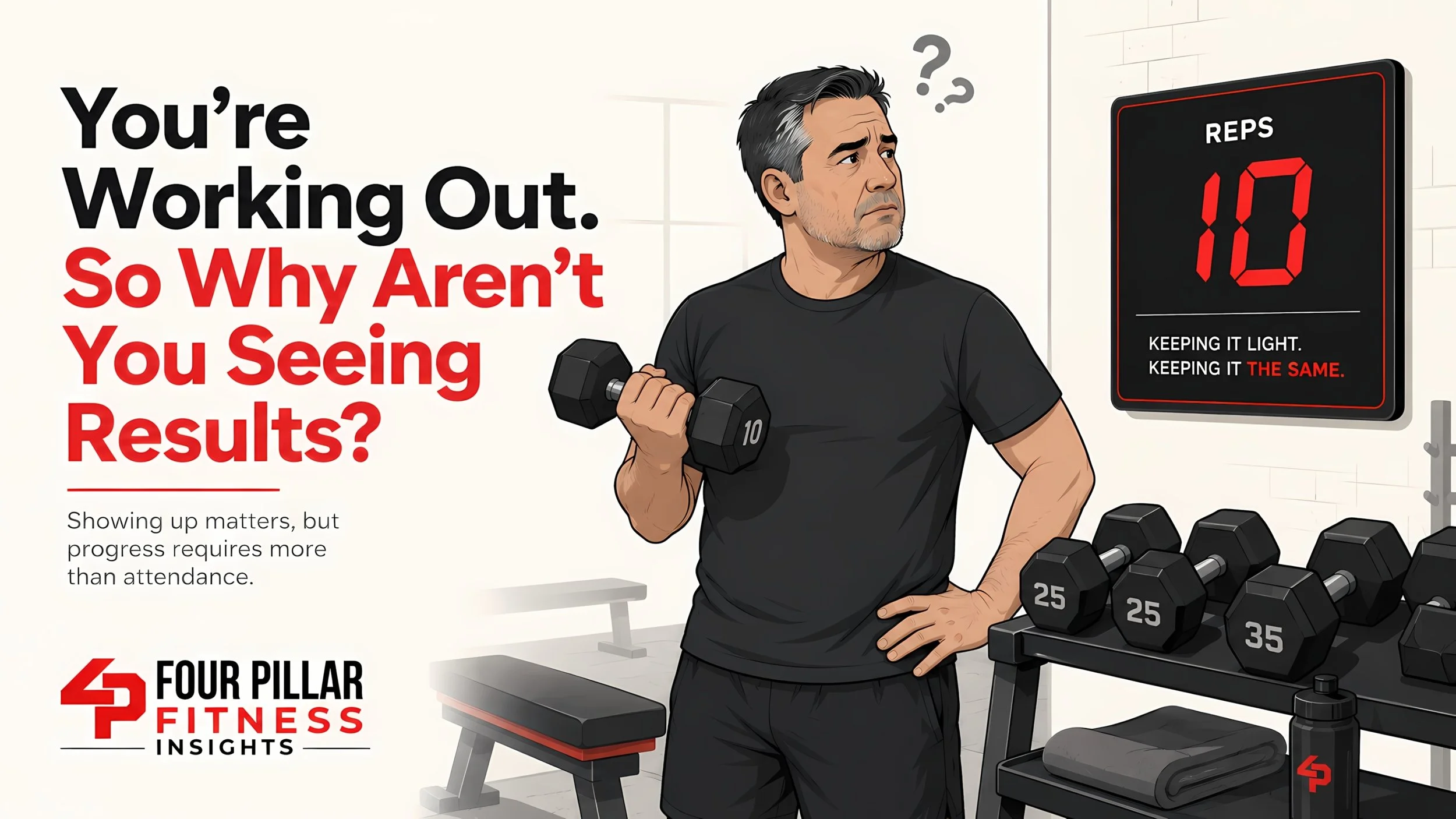
A woman I’ve known at the gym for several years stopped me recently to ask for training advice. She shows up regularly, puts in the time, and wants to lose weight and improve her fitness. But she isn’t seeing the results she expected.
We spent about 15 minutes talking about how she trains. She doesn’t follow a structured program or record her exercises from one workout to the next. Like many gym members, she chooses a familiar weight, completes 10 repetitions, and moves on. Ten has become the finish line, whether the weight was challenging or she could have completed many more repetitions.
That may look like a completed set, but the body doesn’t respond simply because you counted to 10. It responds to the challenge created by the set.
I explained progressive overload and why a working set should generally finish close enough to muscular failure that the final repetitions require real effort. That doesn’t mean every set must reach complete failure. It means the weight and repetition range should challenge the muscle rather than allowing someone to stop with plenty left in reserve.
Our conversation also revealed a larger issue. We focused only on what she was doing inside the gym. We didn’t discuss her nutrition, sleep, daily movement, stress, or recovery. Any of those factors could also be affecting her progress. Showing up matters, but showing up without a clear plan is only the beginning.
Attendance Isn’t the Same as Progress
Anyone who trains consistently deserves credit, especially when work, family, and other responsibilities compete for time. But attendance only tells us that you arrived. It doesn’t tell us whether your workouts are giving your body a reason to change.
You can repeat the same exercises, weights, and repetitions for months until the routine provides little new stimulus. At that point, you may be maintaining your current ability rather than building more strength or muscle.
Consistency is powerful when you’re consistent with something that creates adaptation. Repeating the same unstructured routine more faithfully doesn’t turn it into an effective plan.
Counting Reps Isn’t Enough
Many people treat a resistance-training set like a checklist. They complete 10 or 12 repetitions because that’s the number they’ve always used, then move to the next exercise. The problem is that 10 repetitions can mean very different things.
One person may complete 10 repetitions with a load they could have lifted another 10 times. Another may reach 10 with only one or two good repetitions remaining. Both completed the same number, but the muscular challenge wasn’t the same.
Muscle growth is influenced by how close a set is taken to failure, although every set doesn’t need to reach complete failure. The goal is to make working sets genuinely challenging while maintaining sound technique.
At the end of a working set, ask yourself: How many more good repetitions could I honestly have completed? If the answer is eight or ten, you probably stopped because you reached a familiar number, not because the muscle received a strong training stimulus.
Progressive Overload Gives the Body a Reason to Adapt
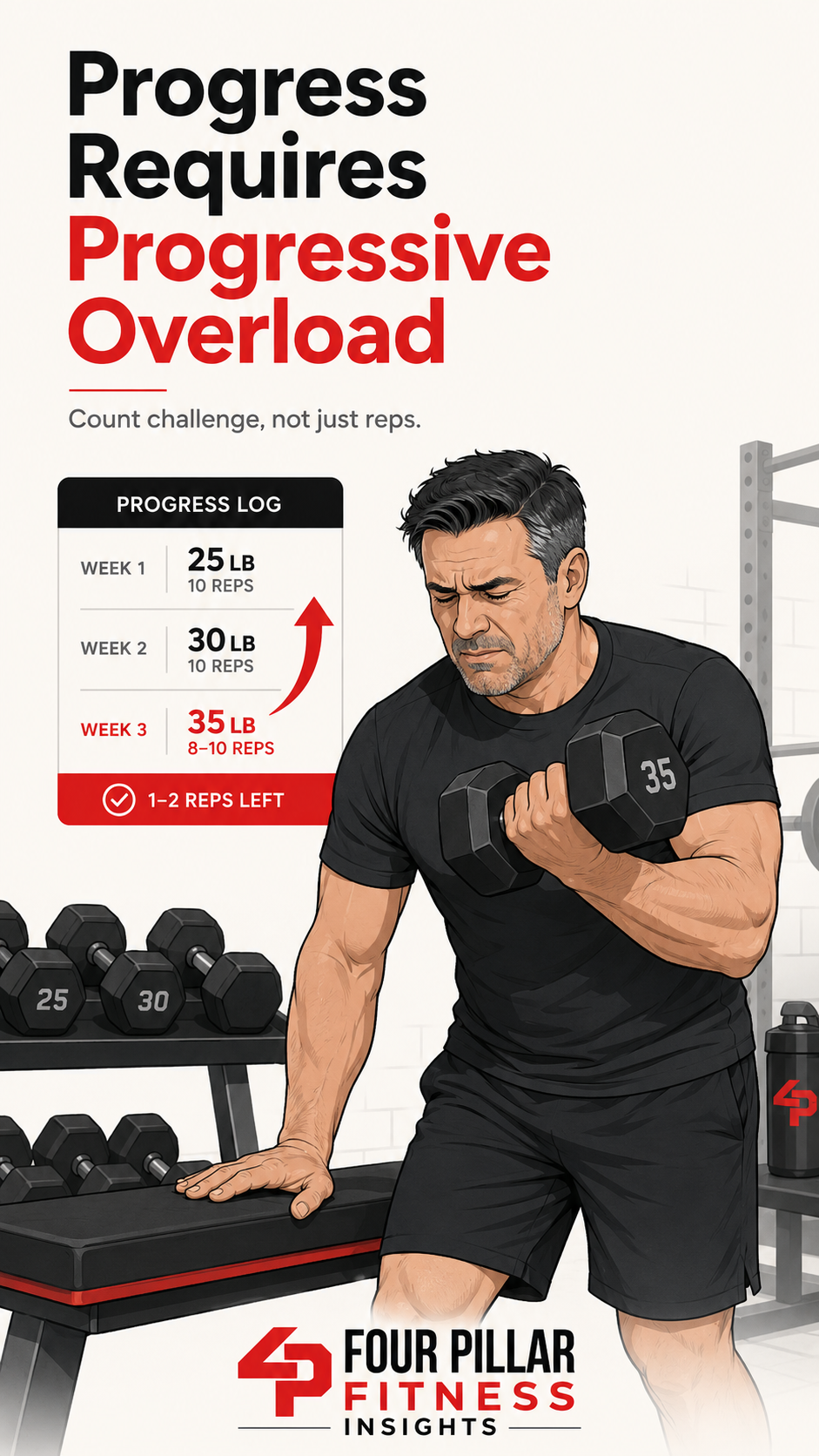
Progressive overload means gradually increasing the demand placed on the body. It can come from increasing resistance, completing more repetitions, improving control, using a fuller effective range of motion, adding a set, or choosing a harder variation.
The demand should progress in a measurable way. This is where a training log becomes useful. Without a record, it’s easy to believe you’re progressing when you’ve actually used the same weights and repetitions for months.
You don’t need a complicated spreadsheet. Recording the exercise, weight, repetitions, and how difficult the set felt is enough to show whether your performance is improving.
Your Workout Must Match Your Goal
Many people say they want to get fit, tone up, lose weight, or become healthier. Those goals are often too vague to guide a program.
What are you actually trying to improve? Strength requires exercises and loads that build force. Body composition requires resistance training that preserves or builds muscle while nutrition supports fat loss. If mobility limits your training, usable range of motion may need more attention.
You can pursue more than one outcome, but the program still needs a clear priority. Random exercises may create sweat, soreness, and fatigue without creating a coordinated path forward.
Ask yourself: What result is my current routine actually designed to produce? If you can’t answer that, your workouts may be active, but they may not be purposeful.
“I Eat Clean” Isn’t a Nutrition Assessment
Ask people about their nutrition and many will say, “I eat clean.” That phrase usually means they believe most of their food choices are healthy. That may be true, but it doesn’t tell us enough to explain their results.
A person can eat nutritious foods and still consume more calories than they realize. Portions may be larger than expected. Cooking oils, dressings, drinks, restaurant meals, snacks, and weekend habits can add more energy than someone accounts for. A person may also eat too little protein to support training and muscle goals.
Food quality matters, but so do quantity, protein intake, meal patterns, and consistency. This doesn’t mean everyone needs to track every bite forever. When progress has stalled, however, a short period of honest observation can reveal what “eating clean” is leaving out.
Try recording everything you normally eat and drink for several days, including one weekend day. Don’t change your behavior to make the record look better. The purpose isn’t judgment. It’s accuracy.
Many people discover that their nutrition is less consistent than they believed. Balanced breakfasts and lunches may be offset by dinners, drinks, snacks, or weekends. Others aren’t eating enough protein or underestimate portions. You can’t adjust what you haven’t honestly examined.
The Hours Outside the Gym Still Count
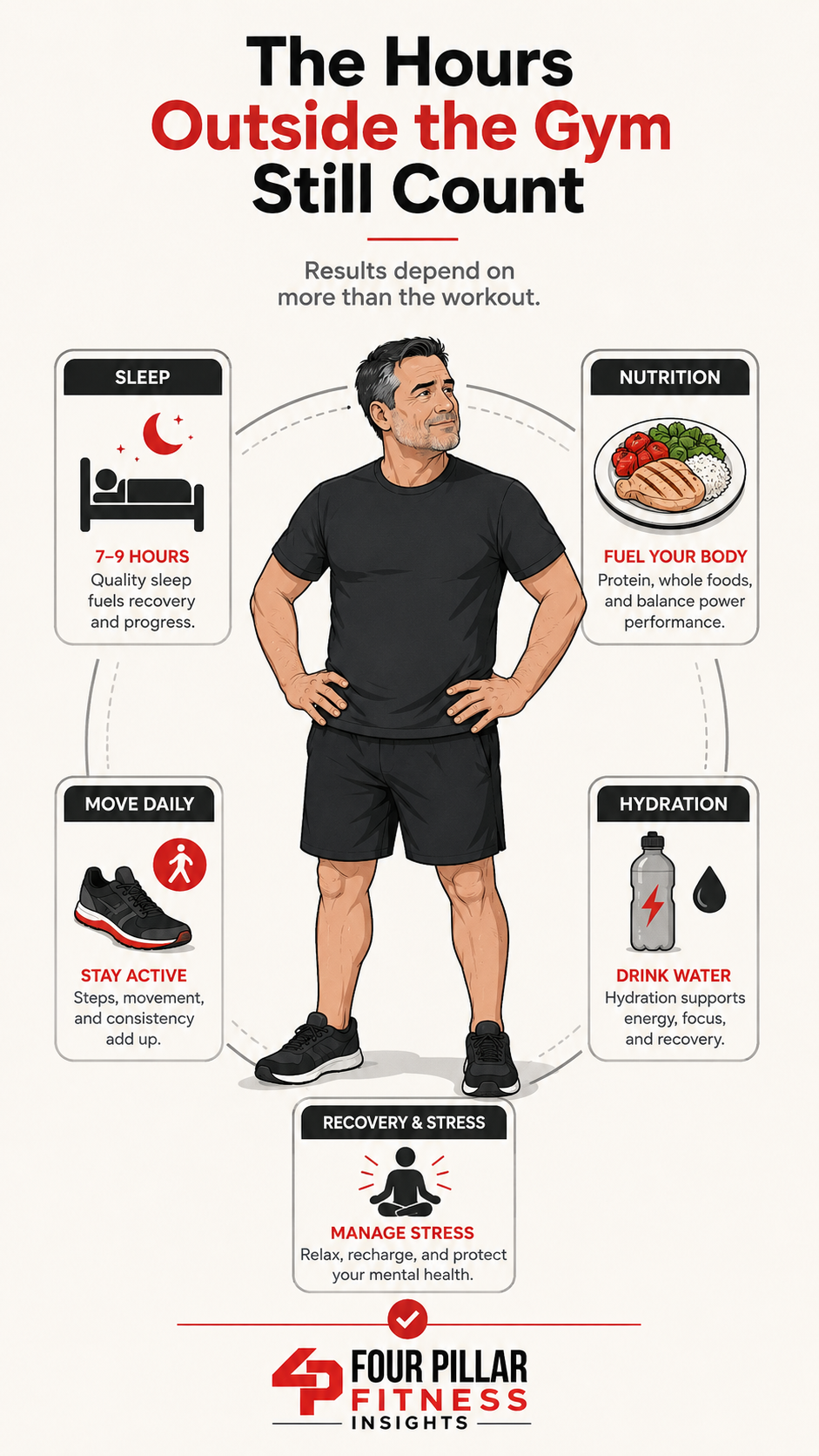
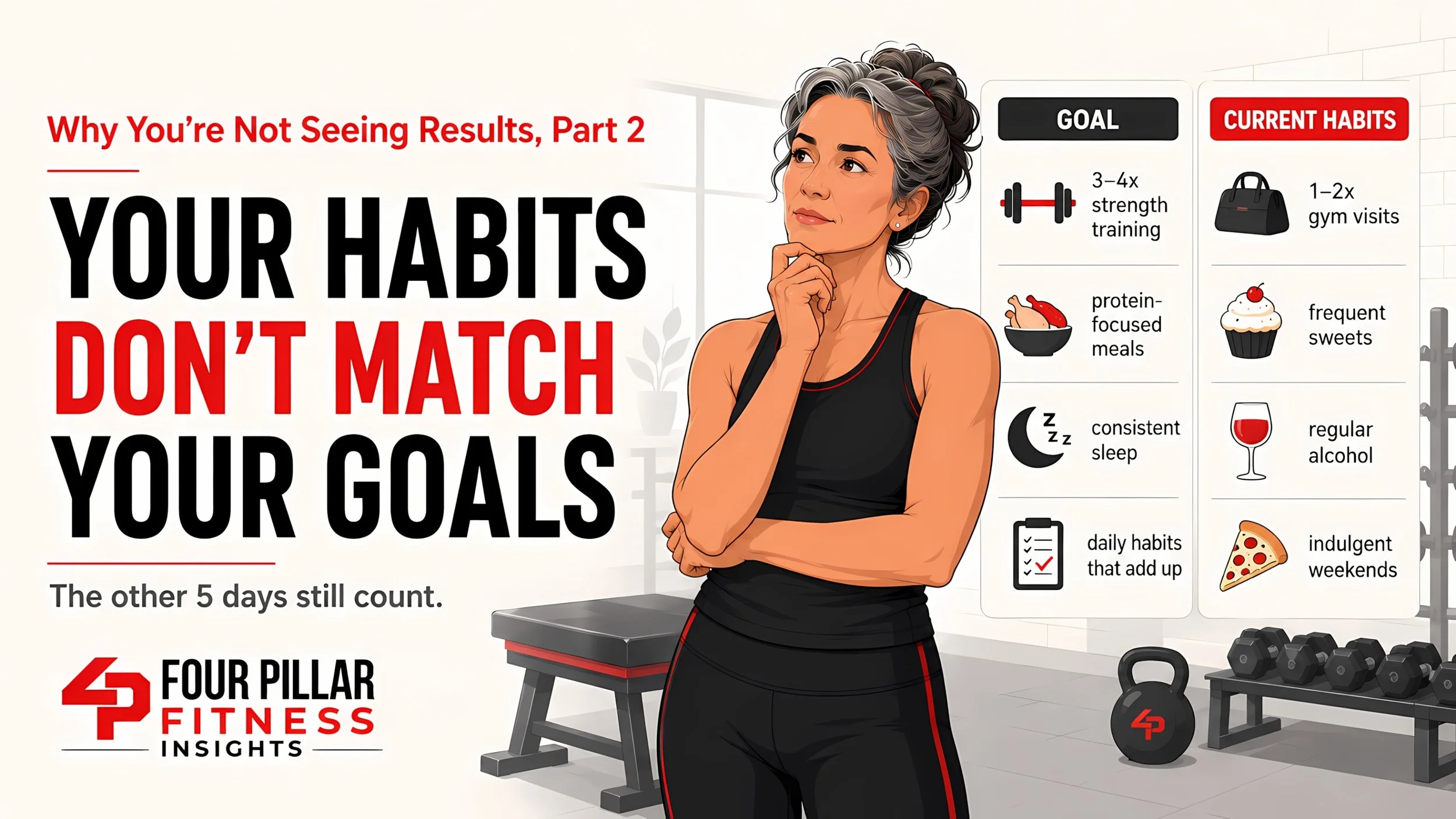
A person who trains four hours per week still spends another 164 hours outside the gym. Those hours include sleep, meals, work stress, alcohol, sitting, walking, and recovery between sessions. The workout creates a stimulus, but the rest of your lifestyle influences how well your body responds.
Poor sleep may reduce training quality and recovery. High stress can disrupt eating and training, while low daily movement may also limit progress.
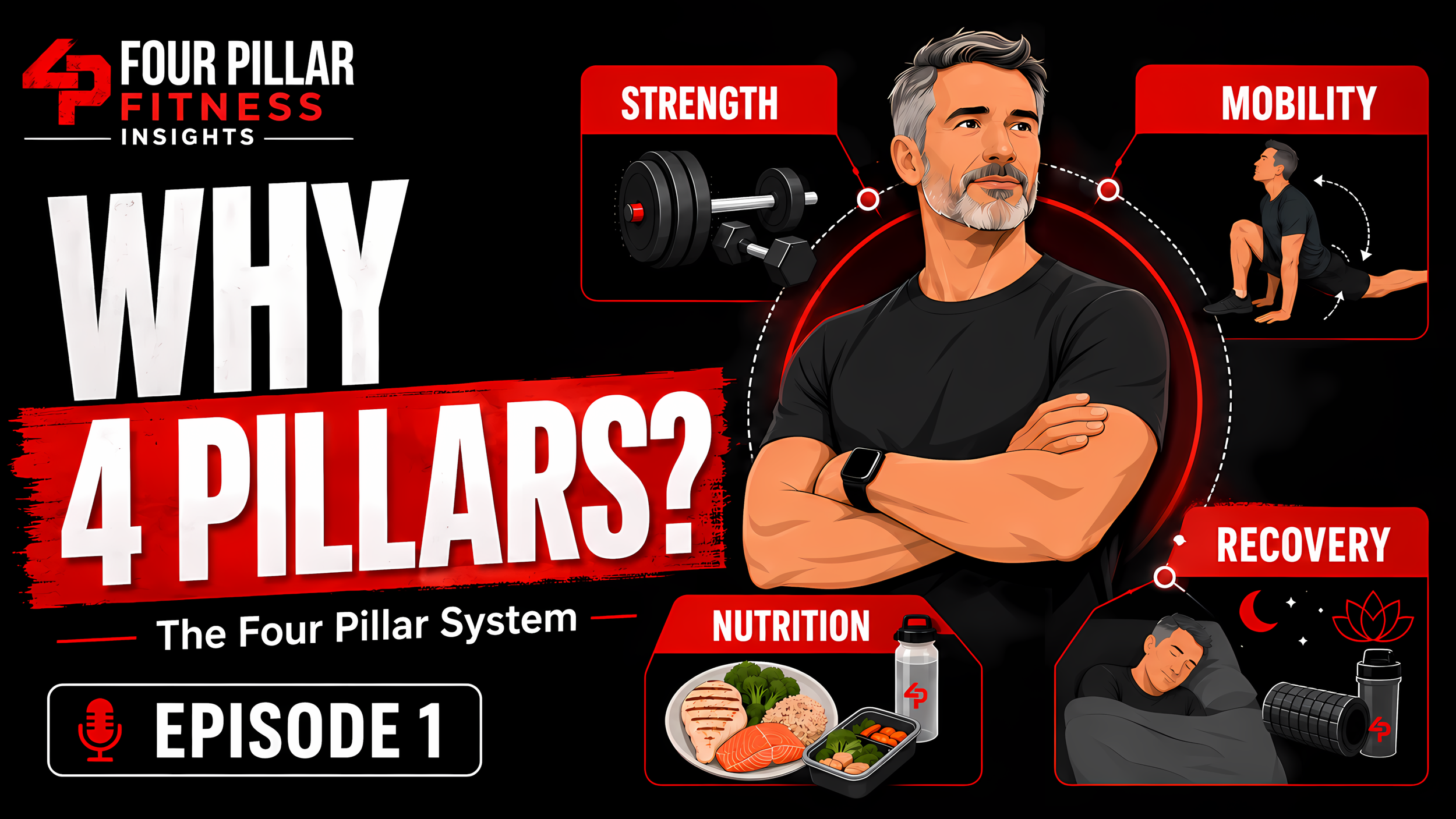
This is where the Four Pillar Fitness system becomes practical. Strength training provides the physical challenge. Mobility helps you access and control useful movement. Nutrition provides energy and building materials. Recovery gives your body the opportunity to adapt.
One pillar can’t always compensate for neglecting the others. You may be training hard enough but eating in a way that doesn’t support fat loss. You may be eating well but following workouts that never progress. You may be doing both but sleeping five hours a night and struggling to recover. Progress often stalls because the pieces aren’t working together.
Measure What You Want to Improve
Sweat, soreness, and exhaustion can make a workout feel productive, but they aren’t reliable measures of progress. Better measures include weights and repetitions, repetitions left in reserve, body-weight or waist trends, body composition, movement quality, recovery, and daily physical ability.
You don’t need to track everything. Choose measurements that match the goal. If you want to get stronger, record performance in your main exercises. If fat loss is the goal, look at trends over time rather than reacting to a single weigh-in. If better movement is the goal, track range, control, comfort, and what you can now do more easily.
What gets measured can be adjusted. What remains vague is difficult to improve.
Before You Add More, Find the Weak Link
When progress stalls, the usual response is to add more: more cardio, more workouts, more exercises, more restrictions, or more supplements. More may be necessary, but it shouldn’t be the automatic answer.
Before adding anything, ask yourself:
What specific result am I training for?
How has my program progressed during the past eight weeks?
How close to failure are my working sets?
Does my nutrition honestly support my goal?
Am I sleeping and recovering well enough to adapt?
What measurement proves that I’m improving or stalled?
Don’t overhaul everything at once. Identify the clearest weak point and start there.
The woman who stopped me is already doing something important. She keeps showing up and was willing to ask questions. Her next step may not be more exercise, but more structure, progression, and support outside the gym.
That’s one reason I wrote The Four Pillars of Fitness. Most people don’t need another random workout or another strict food rule. They need a practical way to connect strength, mobility, nutrition, and recovery to a clear goal.
The book launches August 14, 2026. But you don’t need to wait until then to ask the question that may change your progress:
Are you giving your body a clear reason to change? Leave a comment below.
Stephan Earl is a NASM Certified Personal Trainer, Nutrition Coach, and Corrective Exercise Specialist dedicated to helping people build lasting strength and mobility at every age. With a focus on practical, sustainable fitness, he combines science-based training with mindful movement and nutrition.
He's the author of Yoga Strong: 100 Asanas for Strength of Body and Mind and the forthcoming book The Four Pillars of Fitness: A Simple, Science-Backed System for Strength and Longevity, which explores how to stay strong, mobile, and energized for life. His mission is to help others move better, feel better, and live fully at every stage of their fitness journey.
Learn More
Four Pillar Fitness is built on one clear idea. Strength, Mobility, Nutrition, and Recovery work together to keep you strong and independent at every age. To dive deeper into each pillar, visit 4PFitness.com.
References
Grgic, J., Schoenfeld, B. J., Orazem, J., & Sabol, F. (2022). Effects of resistance training performed to repetition failure or non-failure on muscular strength and hypertrophy: A systematic review and meta-analysis. Journal of Sport and Health Science, 11(2), 202–211.
Refalo, M. C., Helms, E. R., Hamilton, D. L., Fyfe, J. J., & MacInnis, M. J. (2023). Influence of resistance training proximity-to-failure on skeletal muscle hypertrophy: A systematic review with meta-analysis. Sports Medicine, 53, 649–665.
Plotkin, D. L., Coleman, M., Van Every, D. W., Maldonado, J., Oberlin, D., Israetel, M., Feather, J., Alto, A., Vigotsky, A. D., & Schoenfeld, B. J. (2022). Progressive overload without progressing load? The effects of load or repetition progression on muscular adaptations. PeerJ, 10, e14142.
Burke, L. E., Wang, J., & Sevick, M. A. (2011). Self-monitoring in weight loss: A systematic review of the literature. Journal of the American Dietetic Association, 111(1), 92–102.
Knowles, O. E., Drinkwater, E. J., Urwin, C. S., Lamon, S., & Aisbett, B. (2018). Inadequate sleep and muscle strength: Implications for resistance training. Journal of Science and Medicine in Sport, 21(9), 959–968.

More Health & Fitness Insights…

Visit the 4P Fitness PRO Shop
Gear up with fitness-inspired apparel, drinkware, journals, instant downloads, and a little gym and coach humor for the people who train hard, recover smart, and still know how to laugh between sets.
Shop the 4P Fitness Pro Shop and find something that fits your fitness life.

Can you build muscle and lose fat after 50? Yes, but the process depends on more than training hard or eating more. Learn how calorie intake, protein, alcohol, recovery, training history, body recomposition, smart-scale readings, and realistic timelines affect muscle gain and fat loss as you get older.