

Build, Maintain, Defend: A Smarter Way to Think About Strength for Life
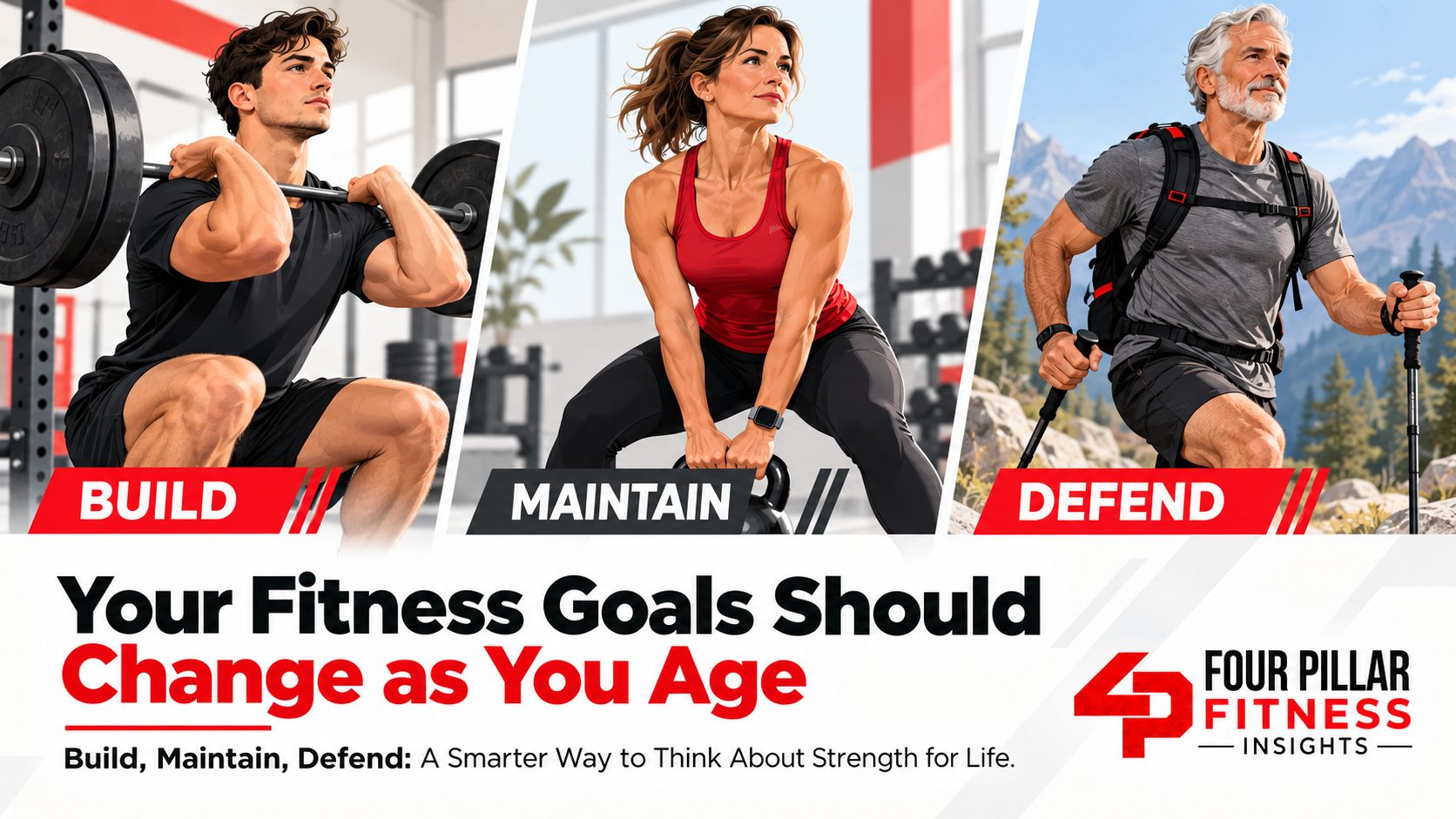
Why the job of fitness changes across life, and why getting older doesn’t mean you stop building strength.
The workout that makes sense at 25 may not be the workout you need at 45 or 70. That doesn’t mean you should expect less from your body as you get older. It means the job of fitness changes.
Earlier in life, we have an opportunity to build physical capacity. As we move through adulthood, protecting what we’ve built becomes increasingly important. Later in life, strength, muscle, mobility, bone, balance, and physical function become assets we need to defend more intentionally.
I call this Build, Maintain, Defend, a framework from my book, The Four Pillars of Fitness. It’s a way to think about fitness across an entire lifetime instead of treating every decade like another attempt to recreate your twenties.
There’s an important distinction, though. These aren’t rigid age brackets. You don’t wake up on your 50th or 65th birthday and suddenly enter a new category. Build, Maintain, Defend is a continuum. Your age matters, but so do your training history, health, stress, sleep, nutrition, injuries, work, and life circumstances.
The simplest way I’ve found to explain it is this:
Age influences the stage. Life circumstances influence the season.
Your fitness plan should serve the body and life you have now, not some previous version of yourself.
Build: Make the Deposits
The Build stage is generally associated with childhood, adolescence, and early adulthood. These are important years for developing strength, muscle, coordination, movement skills, and bone.
Bone provides an easy example. Much of our bone mass is accumulated during childhood and adolescence, with peak bone mass generally reached by young adulthood. Building a strong skeletal foundation early can influence bone health later in life.
But being young doesn’t automatically build a capable body. You still have to provide the stimulus.
This is a great time to learn how to squat, hinge, push, pull, carry, brace, run, jump, and control your body. It’s also a time to develop habits around nutrition, sleep, recovery, and regular physical activity that may continue paying dividends for decades.
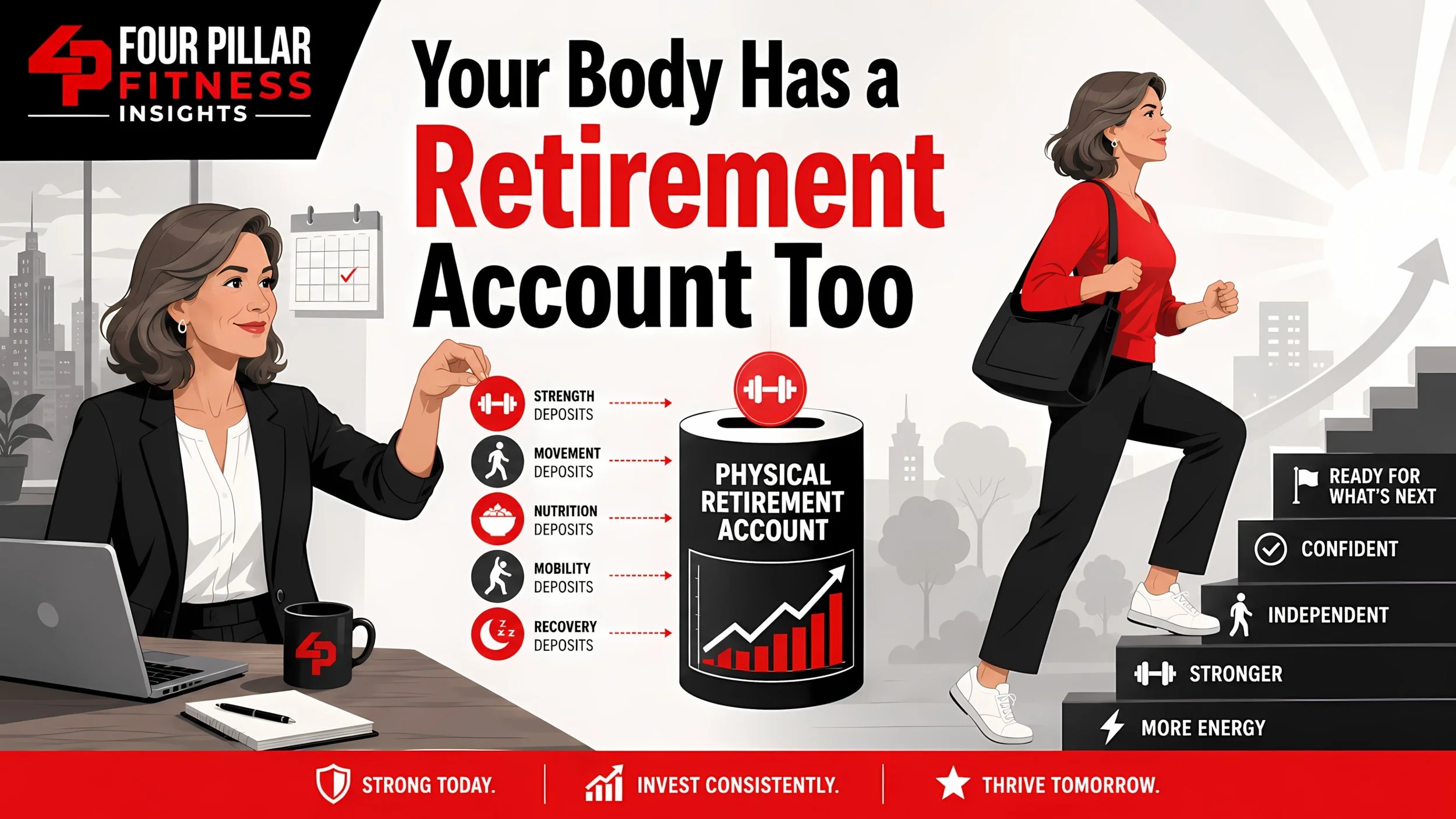
In my book, I describe physical capacity through the idea of the Longevity Bank. Think of muscle and strength as valuable physical assets. Strength training, supportive nutrition, movement, and recovery are deposits. Over time, those deposits help create physical reserve you may need later.
During the Build stage, you have a tremendous opportunity to grow that account. The mistake is assuming the account fills itself because you’re young. A sedentary 25-year-old can still become weaker, less mobile, and less conditioned. Youth may provide a larger margin for error, but it doesn’t make good habits automatic.
The goal is to build the reserve while you have the opportunity.
Maintain: Protect What You’ve Earned
The Maintain stage becomes increasingly relevant through adulthood and midlife, and this is often where life gets louder.
Careers become demanding. Families need time. Travel, deadlines, errands, stress, and responsibilities pile up. Sleep gets squeezed. Training becomes something you try to fit around everything else.
This is also where physical capacity can begin slipping away without much fanfare.
Aging is associated with gradual changes in muscle mass, muscle quality, and strength, but age is only part of the picture. Physical inactivity, illness, poor nutrition, sedentary behavior, and other lifestyle factors can contribute to or accelerate those changes.
That’s one reason I don’t view maintenance as failure.
If you’re 48, working a demanding job, managing a family, traveling, and still protecting most of your strength, muscle, movement, and conditioning, that matters. You’re protecting the balance in your Longevity Bank while continuing to make deposits when life allows.
Maintenance doesn’t mean you stop improving. You may still gain strength, add muscle, improve body composition, or move better. The difference is that improvement now exists alongside preservation.
Maintenance is active protection.
Sometimes maintaining your strength through a difficult six months is exactly what puts you in position to start building again when life settles down.
Defend: Protect Your Physical Reserve
Later in adulthood, the mission increasingly shifts toward defending physical capability. That word can sound passive, but Defend doesn’t mean surrender.
It means recognizing that muscle, strength, bone, balance, mobility, and physical function have become increasingly valuable assets. You train because you intend to keep them.
Sarcopenia refers to age-related deterioration in muscle strength, muscle quantity or quality, and physical performance. Aging contributes to the process, but inactivity and other health and lifestyle factors can also play important roles.
The encouraging part is that older muscle can still respond to training.
Systematic reviews and meta-analyses in older adults show that resistance training can improve strength, muscle mass, walking ability, and physical function. The exact results vary based on training history, health, program design, and adherence, but the larger message is clear: older adults can still adapt.
Bone deserves attention too. Progressive resistance training can improve strength and may help maintain or improve bone mineral density at some skeletal sites. The bone response is generally more modest and more variable than the strength response, but the loading stimulus still matters.
That’s what Defend is really about. You’re giving your body a reason to keep the physical resources you still need, while continuing to build where progress is possible.
Your Stage Isn’t a Sentence
This is where Build, Maintain, Defend can easily be misunderstood.
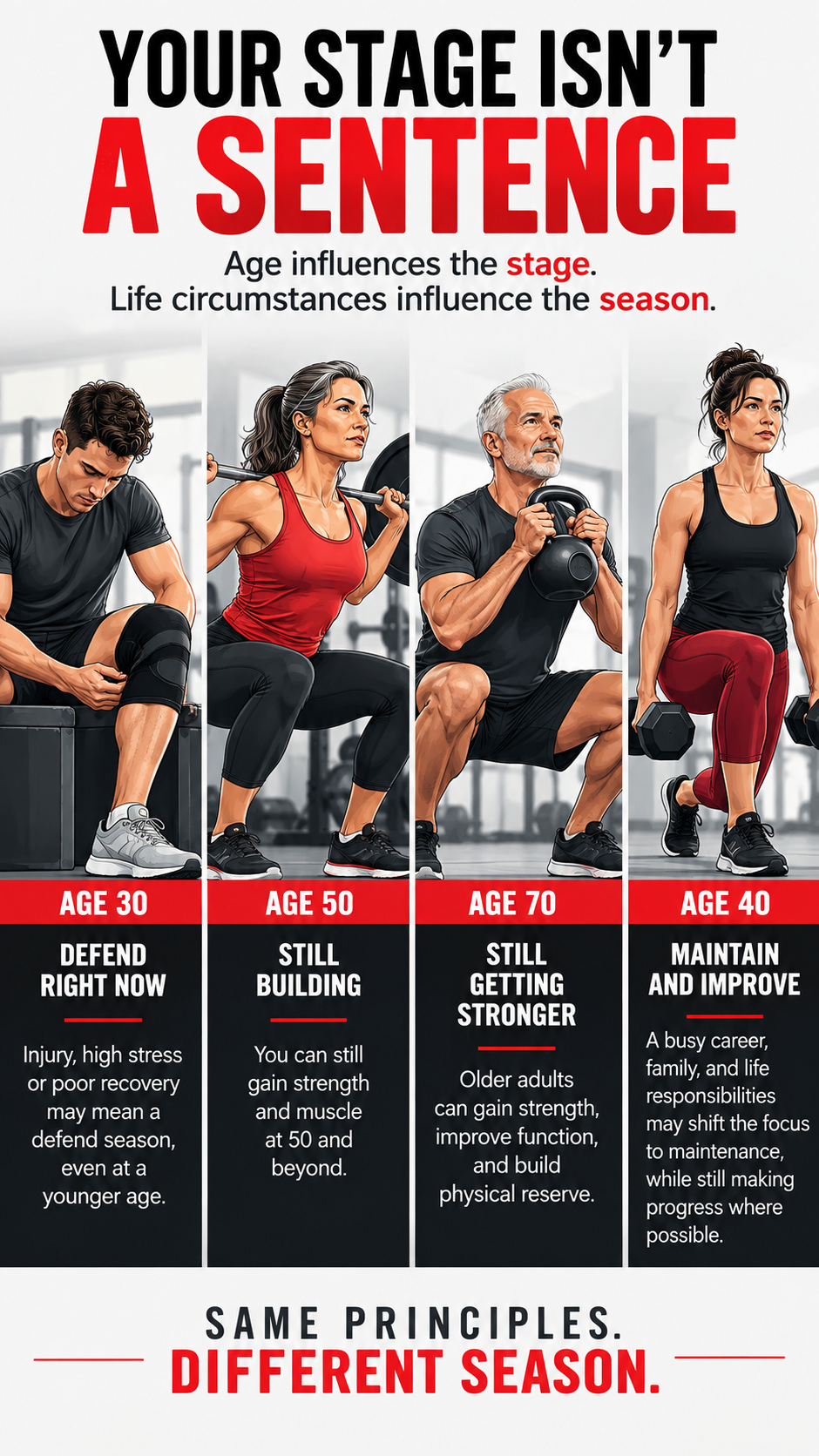
A 50-year-old can absolutely build muscle. A 70-year-old can gain strength. A well-trained older adult may have far more physical capacity than someone decades younger who rarely exercises.
The opposite can happen too. Someone in their thirties dealing with an injury, extreme work stress, poor sleep, or a major life disruption may temporarily need a Defend mindset. Their immediate priority may be protecting strength, movement, and consistency until circumstances improve.
That’s why the stages overlap. Age provides biological context, while your current life adds another layer.
Age influences the stage. Life circumstances influence the season.
The broader scientific view of muscle health across the lifespan follows a similar pattern. The European Working Group on Sarcopenia in Older People has described the life-course goal as maximizing muscle in youth and young adulthood, maintaining it through middle age, and minimizing loss later in life.
None of that means progress has an expiration date. The mission changes, but your ability to adapt doesn’t simply switch off.
The Four Pillars Still Do the Work
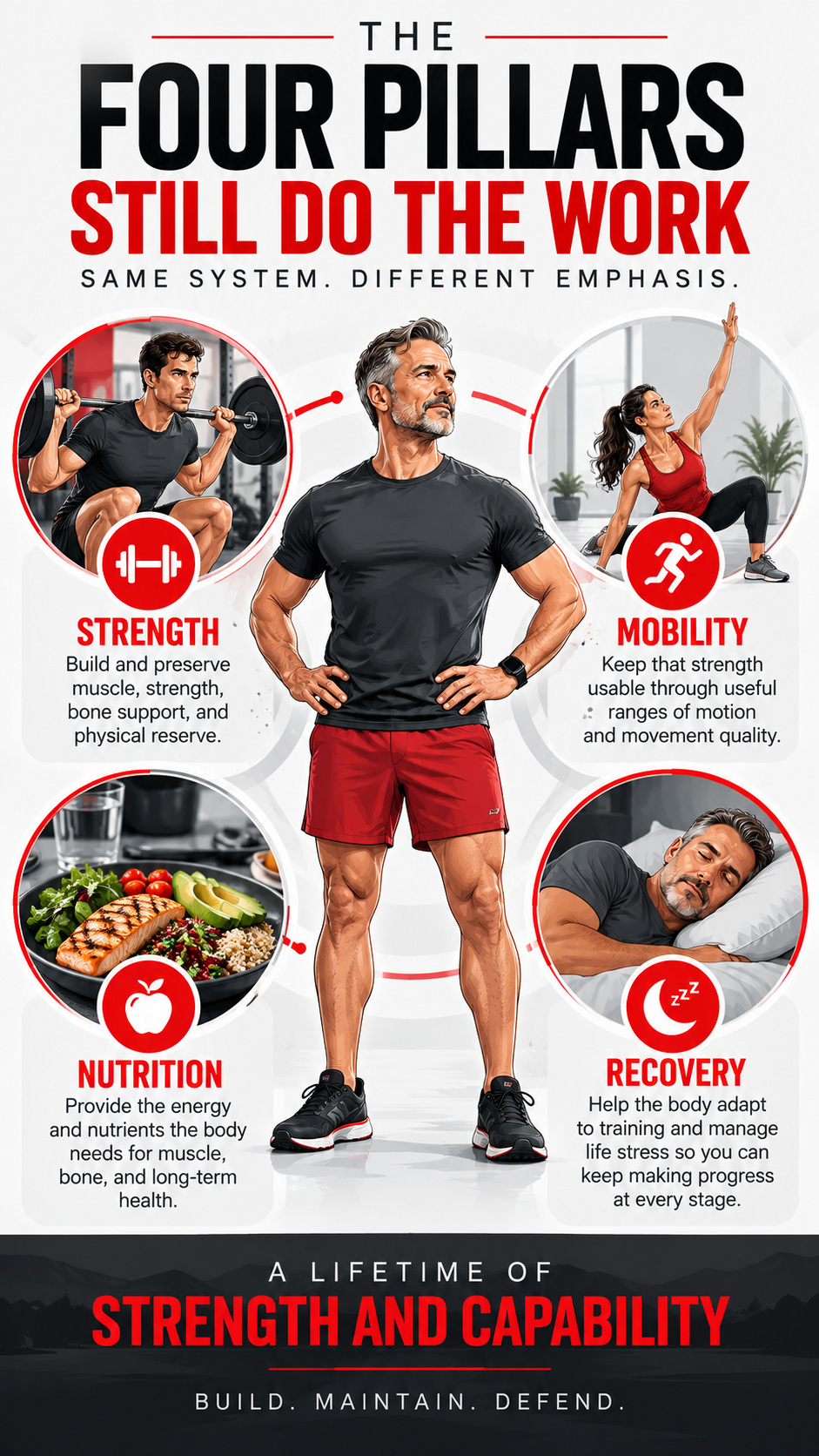
Build, Maintain, Defend changes the emphasis of your fitness plan, but the underlying system remains the same.
Strength provides the stimulus to build and preserve muscle, strength, and physical reserve. As we age, resistance training remains one of our most useful tools for maintaining physical capability.
Mobility helps keep that strength usable. Strength matters more when you can apply it through the ranges of motion and movement patterns your life requires.
Nutrition provides energy and raw materials. Adequate protein, calories, vitamins, minerals, hydration, and an overall nutritious diet support muscle, bone, training, and recovery.
Recovery gives your body the opportunity to adapt. Sleep, stress management, training volume, and rest become increasingly important when life stress and training stress are competing for the same resources.
The pillars don’t disappear as you move through life. The mix simply changes depending on what your body needs most.
What Does Your Fitness Need Right Now?
Instead of choosing your stage from your birth certificate, look at your current physical capacity.
Are you getting stronger, or have you slowly been losing strength? Are you maintaining muscle? Can you move through the activities you enjoy without unnecessary limitations? Has your balance changed? Are you recovering well from training? Is your nutrition supporting what you’re asking your body to do?
Then look at your life.
If you have the capacity to push forward, build. If life is demanding and holding your ground is the realistic goal, maintain. If strength, muscle, mobility, balance, or function are slipping, defend them intentionally while looking for opportunities to rebuild.
You may even be doing all three at once. You could be building upper-body strength, maintaining lower-body muscle, and defending mobility around a previously injured hip. That isn’t a flaw in the framework. That’s real life.
If you’re not sure whether your training should be focused on building, maintaining, or defending right now, that’s one of the things I work through with my coaching clients. The goal isn’t to hand you a generic program based on your age. It’s to build a plan around your current strength, schedule, recovery, nutrition, and goals. If you’d like help putting that into practice, you can learn more about my online strength and nutrition coaching.

Fitness Has a Different Job Now
The goal of lifelong fitness isn’t to train exactly the same way forever. It’s to build physical capacity when you have the opportunity, protect what you’ve earned as life becomes more demanding, and defend the strength and function that keep you capable as you grow older.
Your Longevity Bank doesn’t need an unlimited balance. It needs enough reserve to support the life you want to live.
That might mean carrying your own luggage through an airport, getting off the floor without help, hiking on vacation, playing with your grandchildren, working in the yard, continuing to lift weights, or walking up a flight of stairs without giving it a second thought.
Your reason is personal. The principle is simple:
Build when you can. Maintain what you’ve earned. Defend what keeps you capable.
What stage best describes your fitness right now: Build, Maintain, or Defend? And what physical ability are you most determined to carry into the next decade of your life? Leave a comment below.
Listen to the podcast on YouTube.
Stephan Earl is a NASM Certified Personal Trainer, Nutrition Coach, and Corrective Exercise Specialist dedicated to helping people build lasting strength and mobility at every age. With a focus on practical, sustainable fitness, he combines science-based training with mindful movement and nutrition.
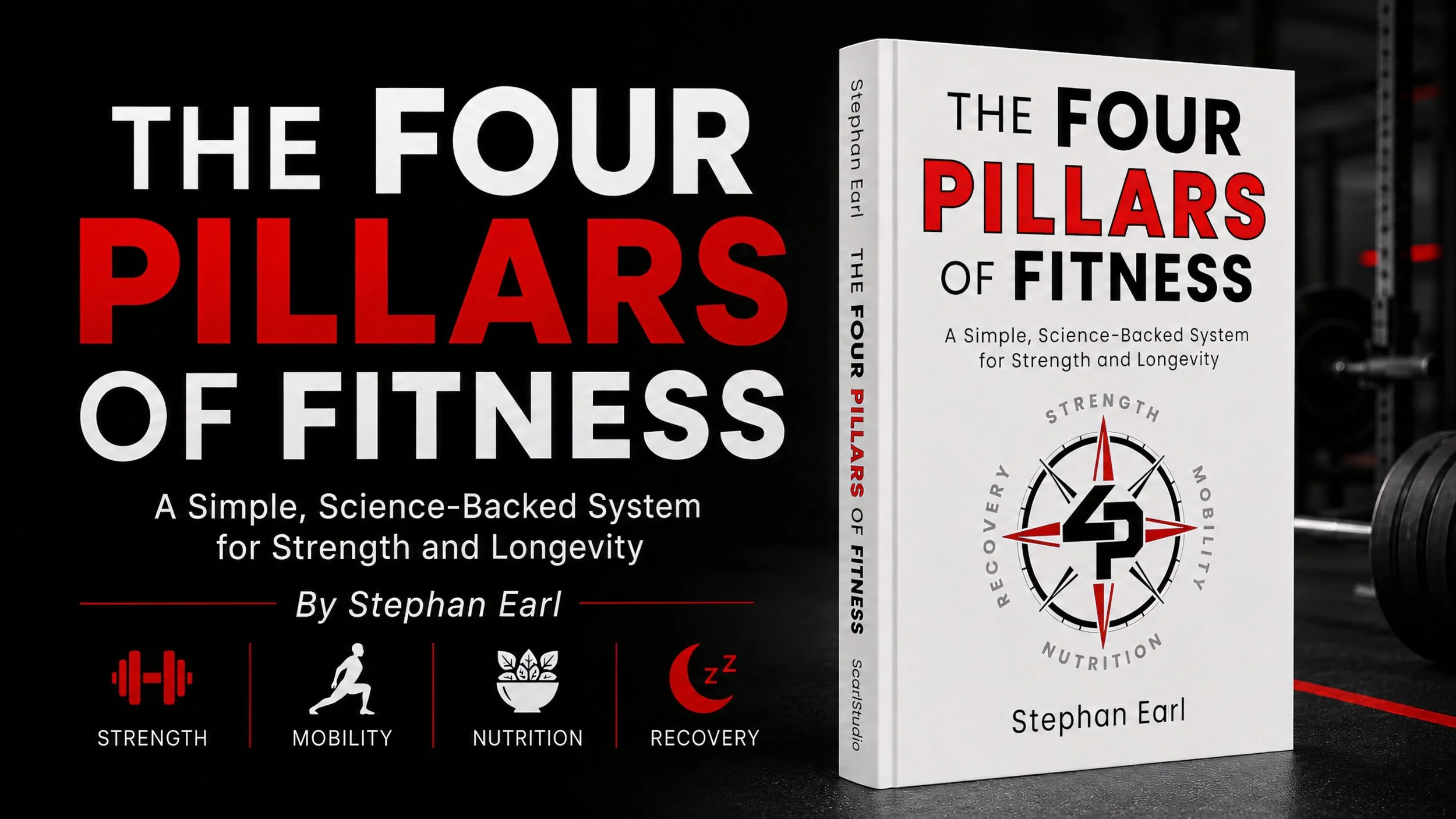
He's the author of The Four Pillars of Fitness: A Simple, Science-Backed System for Strength and Longevity, which explores how to stay strong, mobile, and energized for life. His mission is to help others move better, feel better, and live fully at every stage of their fitness journey.
Learn More
Four Pillar Fitness is built on one clear idea. Strength, Mobility, Nutrition, and Recovery work together to keep you strong and independent at every age. To dive deeper into each pillar, visit 4PFitness.com.
References
Cruz-Jentoft, A. J., et al. (2019). Sarcopenia: Revised European consensus on definition and diagnosis. Age and Ageing, 48(1), 16–31.
Massini, D. A., et al. (2022). The effect of resistance training on bone mineral density in older adults: A systematic review and meta-analysis. Healthcare, 10(6), 1129.
O'Bryan, S. J., et al. (2022). Progressive resistance training for concomitant increases in muscle strength and bone mineral density in older adults: A systematic review and meta-analysis. Sports Medicine.
Tan, Z., et al. (2026). Optimizing prescription of resistance training for body composition, muscle strength, and physical performance in older adults with sarcopenia: A systematic review and meta-analysis. European Review of Aging and Physical Activity, 23, 8.
Yan, R., et al. (2025). Optimal resistance training prescriptions to improve muscle strength, physical function, and muscle mass in older adults diagnosed with sarcopenia: A systematic review and meta-analysis. Aging Clinical and Experimental Research, 37, 320.
Zhang, X., et al. (2026). The intervention effects of resistance exercise on sarcopenia in older adults: A systematic review and meta-analysis. BMC Geriatrics.
More Health & Fitness Insights…


Visit the 4P Fitness PRO Shop

Gear up with 4P Fitness-inspired apparel, gear, and accessories with a little gym humor for the people who train hard, recover smart, and still know how to laugh between sets.
Shop the 4P Fitness Pro Shop and find something that fits your fitness life.

Your fitness goals shouldn’t stay the same forever. The Build, Maintain, Defend framework explains how the job of fitness changes across life, from building strength, muscle, bone, and movement early to protecting physical capacity through midlife and defending strength, mobility, and independence as you grow older.